From Cosmic Technology
The natal Moon Phase is based on the position of the Sun and the Moon, representing the male and female archetypal principles in your natal chart.
The Moon always REFLECTS what the Sun INSTRUCTS.
You can delineate the Moon's position and the Sun's position separately but you will get the most out of it when blending the positions of these points (called "the lights").
They both belong to each other inseparably and should be treated as such.
The Sun-Moon combo influences your life substantially on every level and in many fields and ways.
They also imprint your love life and that's what we are discussing here right now.
It's observed that the Moon phase (lunar phase) you were born under summarizes the core of your life.
Psychological and humanistic astrologers have for long been delineating the Moon phases in this way (think of what the astrologers Raven Kaldera, Dane Rudhyar and Michael Meyer have learned us).
While the delineations of these psychological and humanistic astrologers are highly appreciated, insightful and innovative, they often lack some practical and event-oriented background.
From our own experience and research, we know that the Moon phase in your natal chart has a more practical meaning too and gives information about the way your love life looks like or what kind of a love relationship you do need this life time.
Below, we delineate the 12 different natal Moon phases (thus going beyond the 4 or 8 common Moon phases you may find or read about everywhere else) related to your love life.
In case there is also a tight aspect between the natal Sun and Moon that relates to the phase, the more it will confirm and add to the significations of the described natal Moon phase.
Even if the natal Sun and Moon are not in aspect, they are always building a phase in their relationship with each other so that the below mentioned delineations will work out accurately.
The phases can be found by taking the natal Sun as the "fixed point" and counting the degrees to the faster moving natal Moon.
Now to the natal Moon Phases
Sun conjunct Moon (the Moon is 0° to 30° away from the Sun)
You're never alone and there will always be someone with or standing behind you as a friend or a lover.
In a male horoscope, you will almost always notice a female fan or follower.
It may happen that you live with someone physically but act separately and do your own things. Your relationships often start instinctively and impulsively.
Sun 30° Moon (the Moon is 30° to 60° away from the Sun)
Your relationship can be summarized as a teacher-pupil relationship in which one of both shares experiences with the other.
One of the partners instructs the other who learns from it.You want stability above all.
Sun 60° Moon (the Moon is 60° to 90° away from the Sun)
This is a very communicative relationship with lots of talks and/or messages, calls, texting etc.
You both need a very sociable environment with lots of friends and associates.
You need a partner to co-operate and communicate with others (in groups, in family etc.).
You can't sit still and need movement, trips, changing the place...
Sun 90° Moon (the Moon is 90° to 120° away from the Sun)
The square is an aspect of action and work. You need a relationship to DO things.
Most often the partners are absorbed in (their own) work and career interests. You do need excitement to get the relationship working.
Boredom means the end of the relationship.Your relationship has a fiery character that is often marked by impulsive behavior.
Sun 120° Moon (the Moon is 120° to 150° away from the Sun)
This natal Moon phase brings mutual understanding and some complacency.
You need a partner to spend some time together, relaxing or just having fun. You understand each other instinctively.
Sun 150° Moon (the Moon is 150° to 180° away from the Sun)
This natal Moon phase has very Virgonean traits in which one of the partners is submissive (the servant) and the other is the boss/master.
One of the partners will always have to invest more in the relationship to get it going than the other.
This is not a relationship about equals which you can't stand.
Sun 180° Moon (the Moon is 180° to 210° away from the Sun)
This natal Moon phase is related to irresistible attraction and passion. It's a very magnetic phase, drawing the partners together.
The partners are "out in the open" and this relationship is a public one.
Each partner works on his or her own though and you seek in the other what you cannot achieve alone.
It's a very physical phase that may bring fulfillment of desires.
Sun 210° Moon (the Moon is 210° to 240° away from the Sun)
This natal Moon phase needs intensity and passion.
You need a partner who is completely different and who impresses you profoundly.
Often, one of the partners is or becomes widowed. This can be a temperamental relationship.
Sun 240° Moon (the Moon is 240° to 270° away from the Sun)
Your relationship is another kind of the teacher-pupil relationship in which one of the partners teaches and the other learns.
However, in this mental phase there is more illumination and more inspiration with new (enlightening and impressive) ideas.
You need a partner with insight.
Sun 270° Moon (the Moon is 270° to 300° away from the Sun)
This square too is focused on action.
It's a more forceful relationship though in which one of the partners is the boss/master and the other is the servant.
You need a very organized relationship to get on well, with plenty of appointments and structural and even formal agreements.
In many cases, career drives interfere with your love life in such a way that your career drive ranks higher and needs (or gets) more of your attention.
Sun 300° Moon (the Moon is 300° to 330° away from the Sun)
This relationship is known for the love for children.
Most often, it will not be one's own children, but children of the other (your partner, step-children, adopted children etc...).
Indeed, you need children in your relationship to feel well and fulfilled. Also, there is a lot of socializing too.
Sun 330° Moon (the Moon is 330° to 360° away from the Sun)
In this natal Moon phase you will often need to sacrifice some of your desires or wishes that will not come true -- for the sake of your partner and/or relationship.
This relationship is focused on admiration and one of the partners looks upon the other in a guru-like way.
It's possible that you (un)consciously hide some life events or plans or that you don't want to disclose everything -- for good or bad.
You have your secrets.
Source: https://www.cosmitec-astrological-compatibility-advice.com/natal-moon-phase.html
Showing posts with label Love. Show all posts
Showing posts with label Love. Show all posts
Thursday, 30 May 2019
Monday, 9 January 2017
How We Can Find If Two Persons Are Twin Flames
by Christos Archos, M.Sc
This article by Christos Archos has been split into three parts.
Part 1: Twin Flames Part 2: What are the Twin Flames? Part 3: Identifying Twin Flames
An astrologer usually has a difficulty time answering if two persons are each others twin flame because the basic instruments are not helpful. Longitudanal charts as we know them are not very helpful if we don’t know some other important techniques.
First of all, we have to understand that according to what we’ve discussed, a twin flame is the other half of the soul when is splits entering the human kingdom through geminian influences. This means our soul splits into opposites and we have to find our other half.
In astrology, we are full of opposites; the chart itself is built through opposites. Aries and Libra, Taurus and Scorpio, Gemini and Sagittarius, Cancer and Capricorn, Leo and Aquarius, Virgo and Pisces. All of these are polarities that work among themselves. It is very important when we try to find our twin soul to share opposing planets with the other person. Astrologers and people usually try to avoid opposition because medieval thought used to believe it was a bad aspect. In fact, oppositions between two charts may create some conflicts, but they are very important when you want to have a relationship that really contributes to individuals.
Planets in opposition between two charts are very important when we try to trigger the twin flame relationship. We have to be very careful because we don’t just want the planets to be in opposition but also in contra-parallel. Only when two planets are in opposition and in contra-parallel can we talk about the possibility of a twin flame relationship.
The first criterion is opposition. The other criterion is a very important concept we call “Antiscia.” The degree when the planet has equal day-time is called antiscia. For example the antiscia of a planet in 21o of Taurus is 09o of Leo.
But according to theory twin flames are not based on similarity, so antiscia is not in reality the real point we look for because a person that has a lot of planets in our antiscia points has similarities with us, not oppositions.
The point that is in opposition with Antiscia is Contra-Antiscia. So a person with his planet in 21o Taurus has his contra-antiscia point in 9o of Aquarius. So when a person has a lot of planets in our contra-antiscia points this means that he is probably a twin flame for us.
At this point, we have to combine both techniques. We have to see if any planets are in opposition and contra-parallel at the same time but also to find if there are any connections with each other’s contra-antiscia points.
Of course there are other secondary things an astrologer should look at. First of all we have to look at whether or not the person of interest has planets in the water houses (fourth, eighth and twelth). Although the fourth house sometimes can give us information about whether or not the person found his “father” or “mother” and not his twin flame, for this reason we have to be careful with the interpretation. The reverse is also very important. If we have planets in the other person’s water houses then we increase the probability of a twin flame relationship.
Secondly we have to see if there are planets of the person who form aspects with our retrograde planets, especially Venus. A lot of people with Venus retrograde have high probability to meet their twin flame. Retrograde planets may sometimes be identified with karma but in fact if the theory of twin flames exists, then every time there is an incarnation, every time our soul happens to split our karma partners may be our twin flame.
The last thing we have to look at is on the Composite chart (the chart where we combine the two persons’ natal charts) is if our twelth and first houses have lots of planets. The most important thing is if there is a spark. As we said before there has to be a spark, a light between two people, a flame of passion, love and understanding that they have never felt before. Combining the emotions of the couple and the astrological influences we can easily understand if that is a twin flame relationship or not.
While twin flame is the triumph of uniqueness with another person, having a relationship with any other person on this planet is also very fascinating and generates a big and long path of wisdom and happiness. Don’t forget that the most important thing is not if the relationship we have is a twin flame but if it has the flame to make us different and better. Love is the ultimate weapon of spiritual alchemists, through love you can change a simple relationship to a golden union, the sacred union.
Till then let love and your inner flame drive you to happiness.
Source: http://omtimes.com/2011/01/what-are-the-twin-flames/3/
Source: http://omtimes.com/2011/01/what-are-the-twin-flames/3/

Sunday, 8 January 2017
Are You Twin Flame Material?
There is a lot of confusion about what a Twin Flame really is and also about the true purpose of a Twin Flame union on earth. So let me begin by clarifying some of the truths and myths about Twin Flames:
A Twin Flame is…
- literally your other half
- someone who will unite with you on earth when you are both ready to form a divine vessel for grace and unconditional love to flow out into the world
- always with you in spirit, even when not physically close
- someone who embodies the divine feminine/masculine in a way that is complementary to you
- a romantic partner in the traditional, third dimensional sense
- something that we all get to experience physically in our current incarnation
- necessarily the same age
- someone who walks up to you out of the blue and tells you they are your Twin Flame (inner knowing, not words!)
However, free will still comes into play and the readiness of each Flame will be tested. The Flame who has spent more time in meditation and done more work in terms of personal/spiritual development will be quicker to remember.
It can be really painful to meet up with your twin flame before they are ready; It is one of the biggest tests of our trust in the ultimate goodness of the Divine that we can encounter here on earth. Please do not despair if this has happened to you. All will be well.
It could be said that Twin Flame love is the most elevated form of divine service, as it becomes physical evidence of unconditional love and divine union which transcends polarity.
Again, the whole purpose of the Twin Flame relationship is service in the form of full embodiment of the I AM presence here on earth.
This does not mean that you and your Flame are some kind of “spiritual upper class,” it simply means that you have reached this stage of your journey by the grace of God.
Some of the signs that you are ready for Twin Flame love are:
- a deep, abiding desire to be a reflection of God’s love and light in the world
- an inner knowing that your Twin Flame is also on the earth plane
- a deep, abiding trust in your own inner knowing
- an awareness that you are here to usher in fifth dimensional living
- a knowing since childhood that there is only One soul that you can unite with in perfection (not to be confused with the Hollywood ideal of the perfect romance!)
- trust that all is well and will be well, always
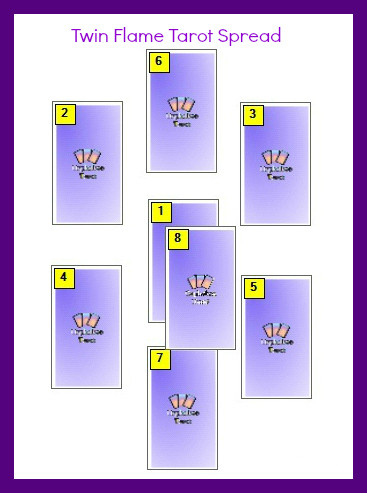
1. Your Readiness to Serve in Twin Flame Capacity
2. Soul’s Purpose Check-Up (you)
3. Soul’s Purpose Check-Up (your Twin Flame)
4. Karmic issue/challenge (you)
5. Karmic issue/challenge (your Twin Flame)
6. How you are already connected (tune into your inner knowing and allow the card image to take you on a journey until you feel a ‘click’ and recognise the connection)
7. Divine guidance about the synchronicities that will bring you together (timing may be indicated here if you are indeed about to be united)
8. Outcome – Shows the most likely outcome in terms of serving together with your Twin Flame in this incarnation.
Use a Tarot deck dedicated to lightwork for this reading, such as the Angel Tarot Cards by Doreen Virtue or the Sirian Starseed Tarot by Patricia Cori.
Please feel free to share your own readings, questions and comments below and don’t forget to share this post on all your social networks if you believe it might be helpful to fellow seekers!
Blessed be!
☆ Lisa Frideborg ☆
Tuesday, 30 August 2016
Astrological Relationship Analysis & Compatibility
By Marlena Applebaum
“A mystic will seek to penetrate the veils through constant and arduous meditation practice, whilst the lover, through his feelings for the beloved, will arrive there in his heart. In this sense, human relationship is spiritual practice, with benefits of equal value.”~Robert P. Blaschke
Astrological relationship analysis is one of my favorite areas of study. While astrological knowledge certainly can’t give any guarantees about whether a relationship will be “successful” or not, it can provide insights into the everyday dynamics of a relationship as well as give some clues about the underlying spiritual journey two people have together. Below is a compilation of gems I have gleaned from my studies as well as observations taken from client experiences and personal experience.
The three main ways I investigate relationships:
Some of the key elements I look at when considering attraction, harmony, and endurability:
Opportune times for love (some examples):
Some of the best information I have found about synastric comparison and the composite chart:
“No amount of love can continually offset lack of harmony in a relationship… It is highly recommended that a minimum ratio of two harmonious aspects to one disharmonious aspect be present when comparing the planets of two individuals involved…” and
“The composite chart is the ‘bottom line.’ If the composite chart is very harmonious, whereas the planetary comparison is not, there is a possibility the relationship can survive… It would also be wise to remember the two-to-one ratio in composites.” ~Nance McCullough
“The Sun, ascendant, or Moon of partner A in partner B’s 7th house makes B feel that A is his/her ideal for a mate; i.e. you are my epitome!” ~Nance McCullough
“Regarding angular love ties (Sun, Moon, Venus, Jupiter of one partner in the 1st and/or 7th house of the other partner) — these ties are felt immediately and are very strong from the beginning… Planetary conjunctions and close trines of the Sun, Moon, Venus, or Jupiter and trines to the ascendant have no impact at first, but every time these two individuals are together, the love between them grows more and more until ‘death due us part.’” ~Nance McCullough
“Sun-Moon conjunctions are the Cadillac of all synastry aspects for marriage, with the trine between the Luminaries, or a Sun-Ascendant conjunction, tying for second place.”~Robert P. Blaschke
“Sun, Moon, Venus, or Mars in one horoscope in the sign ascending or descending in the other horoscope is an astrological testimony of a strong attraction… Unless the Ascendant or Descendant of one horoscope combines with the planets of the other by sign, it is doubtful that the attraction would result in marriage.” ~Lois Haines Sargent
“Contacts with the Ascendant are rather physical and instinctive, and always instantaneous. Contacts with the luminaries are deep and virtually potent.” ~www.astrotheme.com
“The stronger the love tie, the more ecstatic the union. Once you have experienced a fantastic close Venus tie with someone’s Sun, Moon, ascendant, or Jupiter, you will never be satisfied with less.” ~Nance McCullough
“I always take an aspect between the ruling planets (i.e., the rulers of their Ascendants) as a testimony to the fact that the two people are likely to have a relationship of extraordinary intensity and importance… The close interaction of the ruling planets’ energies can be seen as indicative of a particularly specific symbol of how the two people interact with each other… in the vast majority of such cases, all of the other levels of interaction shown in a comparison will be secondary to the intense type of interchange symbolized by the aspect between the rulers.” ~Stephen Arroyo
“The composite chart describes the entity of the relationship itself. When you consider the aspects between the composite chart and the birthcharts, concentrate on the effect that the entity of the couple, symbolized by their composite chart, has on the individual birthcharts.” ~Steven and Jodie Forrest
“It appears that the aspects to the Sun are the heart and soul of any partnership, and, as a composite Sun goes, so goes a relationship.” ~Robert P. Blaschke
“According to many sources, lack of a 7th house composite planet precludes marriage.”~Nance McCullough
“[L. Edward Johndro] felt that the Vertex was the electrical, the Ascendant the magnetic and the MC the gravity axis in a natal chart.” ~Alice Portman
“The astrologer should look for any synastric aspect configurations… Just as marriage vows state that both parties take each other for better or for worse, so too, do shared configurations manifest in either a positive or negative fashion… If a Grand Cross, T-square, or Yod are formed by synastry, then the couple, just by being together, will encounter unexpected stress factors in the relationship… When a Grand Trine is produced by synastry, couple can appear to withdraw into a cocoon, a sort of private world… Couples with synastry Stelliums live as if they are one unified being, made whole by their love.” ~Robert P. Blaschke
Some of the best information I have found about past life links and karmic relationships:
“Ancestral and family karma is found in the 4th house, the karma of loss in the 8th house, and spiritual emancipation in the 12th house… The deepest karmic lessons are usually accompanied by pain and suffering. Can the astrologer see this type of karmic lesson between a couple? Yes, it would be found with an overlay Sun, Moon, or Saturn in the 8th house, with the planets also in synastric square or opposition.” ~Robert P. Blaschke
“When I see a synastric conjunction from one person’s Light or planet to the partner’s natal IC, I interpret it as a past life family connection… The 12th house symbolizes the most recent past life and a synastric conjunction with the 12th cusp is an indicator of two souls having been together in their most immediate past lives. However, the South Node represents the ongoing spiritual growth for as many as seven past incarnations. If the astrologer sees a synastric conjunction to the South Node, he knows that two souls have had a long history.” ~Robert P. Blaschke
“The South Node conjunct a planet is supposedly very karmic and implies that the South Node individual owes the planet individual a debt or service from a previous life.”~Nance McCullough
“One of the jokes that I told is how one, when seeing that another soul has planets on their South Node, instinctively reaches for their wallet and asks, ‘how much do I owe you?’” ~Robert P. Blaschke
“When astrologers see synastric or composite conjunctions to a North Node, they can view this as a karmic credit. In the case of synastry, however, the planet person will repay the Node person in some positive way. When found in the composite chart, couples will have positive karma… As a general rule, the astrologer can interpret synastry conjunctions to the South Node that are not also accompanied by a conjunction to the North Node, as the karma of conscious completion… If there is also a North Node conjunction, astrologers can view this as an ongoing soul connection, continuing into the next life together.” ~Robert P. Blaschke
The Vertex: “This sensitive degree in the horoscope has been associated with fated love, and appears to symbolize relationship brought into one’s life for karmic purposes, such as for the birth of a child, or a life-changing transformative journey together.” ~Robert P. Blaschke
References:
Astrology A Launguage of Life: Volume IV – Relationship Analysis by Robert P. Blaschke
Skymates II: The Composite Chart by Steven Forrest and Jodie Forrest
Love Formulas~2 by Nance McCullough
How to Handle Your Human Relations by Lois Haines Sargent
Astrology Karma & Transformation: The Inner Dimensions of the Birth Chart by Stephen Arroyo
Source: http://www.happinessseries.com/05/2013/astrological-relationship-compatibility/
“A mystic will seek to penetrate the veils through constant and arduous meditation practice, whilst the lover, through his feelings for the beloved, will arrive there in his heart. In this sense, human relationship is spiritual practice, with benefits of equal value.”~Robert P. Blaschke
Astrological relationship analysis is one of my favorite areas of study. While astrological knowledge certainly can’t give any guarantees about whether a relationship will be “successful” or not, it can provide insights into the everyday dynamics of a relationship as well as give some clues about the underlying spiritual journey two people have together. Below is a compilation of gems I have gleaned from my studies as well as observations taken from client experiences and personal experience.
The three main ways I investigate relationships:
- Synastry: This is the comparison of two individual’s natal charts to understand how they affect one another, including aspects between the charts (for example: A’s Sun is conjunct B’s Moon) and house overlays (for example: A’s Sun falls into B’s 11th house, B’s Moon falls into A’s 7th house).
- The Composite chart (the midpoints of A’s & B’s respective planets and angles): This is an illustration of the relationship itself, i.e., the third entity that is created when the two come together (interpreted like a birth chart, but representing the couple as a unit).
- Birth chart analysis — to determine individual propensities in relationship.
Some of the key elements I look at when considering attraction, harmony, and endurability:
- 7th house overlays (the 7th house represents the partner, as well as how the native relates within partnerships): for example, what part of A’s chart falls into B’s 7th house and vice versa; and noting what other houses are overlaid by the other person’s planets and angles — showing main areas of focus in the relationship (such as home, career, finances, or spirituality).
- Ascendant contacts — represent strong attraction indicators and show love & affection.
- Descendant contacts — represent the marriage bond and partnership needs.
- Aspects between personal planets, especially the Sun & Moon, and Venus & Mars —show yin/yang complementarity, attraction, and compatibility.
- The ratio of harmonious to disharmonious aspects between the two individuals and within the composite chart — harmonious aspects give the feeling of being loved effortlessly, whereas disharmonious aspects require growth and change. It is said that a two-to-one ratio of harmony to disharmony is desired to make the relationship sustainable, yet too much harmony can lead to stagnation and lack of personal and spiritual growth. The challenge is working out how to tally this ratio. I am still experimenting with different methods.
- Whether the chart rulers are in aspect and if so, what type of aspect is it, as this represents a key dynamic between the two individuals.
- Whether the chart ruler of one is conjunct the horizon of the other — represents a strong compatibility indicator.
- Sun conjunct Venus in the composite chart — indicates a foundation of love in the relationship.
- The aspects that the composite chart makes to the two individuals charts — shows how each individual experiences the relationship.
- Planets in the 7th house of the composite chart, or the lack thereof.
- Nodal & vertex contacts — to consider past life links, karma, and “fate”
- Saturn trines between the two show longevity; the Saturn placement in the other’s chart or the composite shows where there is responsibility, seriousness, and duty towards the other, but can also represent limitations or heaviness in the relationship.
- Transits and progressions for the individuals as well as to the composite to consider timing and ripeness/receptivity towards love and relationship.
- The Sabian symbol for the degree of the composite chart ascendant — illustrates a subtle, symbolic flavor of the relationship.
- Aspect configurations between the charts and in the composite — reveals special features about the relationship.
Opportune times for love (some examples):
- Transiting Jupiter through the 5th house (romance), 7th house (partnership), and 8th house (emotional and physical intimacy/bonding) — correlates with opportunity and abundance in these areas.
- Transiting Jupiter conjunct Venus — correlates with an opportunity for love
- Progressed Venus trine progressed Jupiter — same as above.
- Progressed Moon conjunct natal Venus — the heart is ready.
- Synastric timing: for example, progressed Sun of one conjunct natal Venus or natal Moon of the other or progressed Ascendant conjunct natal Ascendant of the other — shows a synchronization between the two, and often reveals the time of meeting.
- The sign on the 7th house cusp and planets in the 7th — signify the type of partner who will be a complement, and in general, the experience the individual has of partnership, as well as the way one is as a partner, oneself. Also, is the individual owning or projecting their 7th house of “other”?
- The ruler of the 7th house — provides further information of the above.
- The condition of Venus, who presides over love and attraction, gives ideas about inherent relationship dynamics for the individual.
- Traditionally the sign, placement, and aspects of the Sun and Mars in a woman’s chart give clues about the partner she will seek.
- Traditionally the sign, placement, and aspects of the Moon and Venus in a man’s chart give clues about the partner he will seek.
- The sign and placement of the asteroid, Juno (Hera), who presides over marriage, gives information about what is desired and needed in a marriage partner.
Some of the best information I have found about synastric comparison and the composite chart:
“No amount of love can continually offset lack of harmony in a relationship… It is highly recommended that a minimum ratio of two harmonious aspects to one disharmonious aspect be present when comparing the planets of two individuals involved…” and
“The composite chart is the ‘bottom line.’ If the composite chart is very harmonious, whereas the planetary comparison is not, there is a possibility the relationship can survive… It would also be wise to remember the two-to-one ratio in composites.” ~Nance McCullough
“The Sun, ascendant, or Moon of partner A in partner B’s 7th house makes B feel that A is his/her ideal for a mate; i.e. you are my epitome!” ~Nance McCullough
“Regarding angular love ties (Sun, Moon, Venus, Jupiter of one partner in the 1st and/or 7th house of the other partner) — these ties are felt immediately and are very strong from the beginning… Planetary conjunctions and close trines of the Sun, Moon, Venus, or Jupiter and trines to the ascendant have no impact at first, but every time these two individuals are together, the love between them grows more and more until ‘death due us part.’” ~Nance McCullough
“Sun-Moon conjunctions are the Cadillac of all synastry aspects for marriage, with the trine between the Luminaries, or a Sun-Ascendant conjunction, tying for second place.”~Robert P. Blaschke
“Sun, Moon, Venus, or Mars in one horoscope in the sign ascending or descending in the other horoscope is an astrological testimony of a strong attraction… Unless the Ascendant or Descendant of one horoscope combines with the planets of the other by sign, it is doubtful that the attraction would result in marriage.” ~Lois Haines Sargent
“Contacts with the Ascendant are rather physical and instinctive, and always instantaneous. Contacts with the luminaries are deep and virtually potent.” ~www.astrotheme.com
“The stronger the love tie, the more ecstatic the union. Once you have experienced a fantastic close Venus tie with someone’s Sun, Moon, ascendant, or Jupiter, you will never be satisfied with less.” ~Nance McCullough
“I always take an aspect between the ruling planets (i.e., the rulers of their Ascendants) as a testimony to the fact that the two people are likely to have a relationship of extraordinary intensity and importance… The close interaction of the ruling planets’ energies can be seen as indicative of a particularly specific symbol of how the two people interact with each other… in the vast majority of such cases, all of the other levels of interaction shown in a comparison will be secondary to the intense type of interchange symbolized by the aspect between the rulers.” ~Stephen Arroyo
“The composite chart describes the entity of the relationship itself. When you consider the aspects between the composite chart and the birthcharts, concentrate on the effect that the entity of the couple, symbolized by their composite chart, has on the individual birthcharts.” ~Steven and Jodie Forrest
“It appears that the aspects to the Sun are the heart and soul of any partnership, and, as a composite Sun goes, so goes a relationship.” ~Robert P. Blaschke
“According to many sources, lack of a 7th house composite planet precludes marriage.”~Nance McCullough
“[L. Edward Johndro] felt that the Vertex was the electrical, the Ascendant the magnetic and the MC the gravity axis in a natal chart.” ~Alice Portman
“The astrologer should look for any synastric aspect configurations… Just as marriage vows state that both parties take each other for better or for worse, so too, do shared configurations manifest in either a positive or negative fashion… If a Grand Cross, T-square, or Yod are formed by synastry, then the couple, just by being together, will encounter unexpected stress factors in the relationship… When a Grand Trine is produced by synastry, couple can appear to withdraw into a cocoon, a sort of private world… Couples with synastry Stelliums live as if they are one unified being, made whole by their love.” ~Robert P. Blaschke
Some of the best information I have found about past life links and karmic relationships:
“Ancestral and family karma is found in the 4th house, the karma of loss in the 8th house, and spiritual emancipation in the 12th house… The deepest karmic lessons are usually accompanied by pain and suffering. Can the astrologer see this type of karmic lesson between a couple? Yes, it would be found with an overlay Sun, Moon, or Saturn in the 8th house, with the planets also in synastric square or opposition.” ~Robert P. Blaschke
“When I see a synastric conjunction from one person’s Light or planet to the partner’s natal IC, I interpret it as a past life family connection… The 12th house symbolizes the most recent past life and a synastric conjunction with the 12th cusp is an indicator of two souls having been together in their most immediate past lives. However, the South Node represents the ongoing spiritual growth for as many as seven past incarnations. If the astrologer sees a synastric conjunction to the South Node, he knows that two souls have had a long history.” ~Robert P. Blaschke
“The South Node conjunct a planet is supposedly very karmic and implies that the South Node individual owes the planet individual a debt or service from a previous life.”~Nance McCullough
“One of the jokes that I told is how one, when seeing that another soul has planets on their South Node, instinctively reaches for their wallet and asks, ‘how much do I owe you?’” ~Robert P. Blaschke
“When astrologers see synastric or composite conjunctions to a North Node, they can view this as a karmic credit. In the case of synastry, however, the planet person will repay the Node person in some positive way. When found in the composite chart, couples will have positive karma… As a general rule, the astrologer can interpret synastry conjunctions to the South Node that are not also accompanied by a conjunction to the North Node, as the karma of conscious completion… If there is also a North Node conjunction, astrologers can view this as an ongoing soul connection, continuing into the next life together.” ~Robert P. Blaschke
The Vertex: “This sensitive degree in the horoscope has been associated with fated love, and appears to symbolize relationship brought into one’s life for karmic purposes, such as for the birth of a child, or a life-changing transformative journey together.” ~Robert P. Blaschke
References:
Astrology A Launguage of Life: Volume IV – Relationship Analysis by Robert P. Blaschke
Skymates II: The Composite Chart by Steven Forrest and Jodie Forrest
Love Formulas~2 by Nance McCullough
How to Handle Your Human Relations by Lois Haines Sargent
Astrology Karma & Transformation: The Inner Dimensions of the Birth Chart by Stephen Arroyo
Source: http://www.happinessseries.com/05/2013/astrological-relationship-compatibility/
Wednesday, 10 August 2016
The Love Degree
Our love degrees are nothing more or less than specific degrees that promote love in an auspicious way when triggered by a (personal) planet/body or point. Numerous books and articles have been written about the meaning of the 360 degrees of the zodiac.
The majority of the authors prefer visionary and spiritual descriptions leaving space for further interpretation and the so-called "free will." The Sabian symbols are a good example and the most popular ones.
The problem with images and symbols is that, while they can be stunningly accurate at times, they can be so vague and unreal that even with a whole lot of phantasy, you can't match them to the event. A little stretch will not hurt, but sometimes you need more than some imagination and a joint to "get the picture."
Astrology is not about guessing...
In our opinion, the most valuable degree meanings are the ones you can quite confidently use to accurately predict future events (not past events!).
If you can't use the the degree meanings to accurately predict future events, you can't use them to delineate past events too because you are interpreting and projecting.
Comparing different methods, we can say from our own experience that the Sabian symbols are not the most accurate ones to predict future events.
If you take the symbolic and philosophical meanings to try to predict future events, you will find no consistency in the accuracy of the predictions. The predictions most often remain superficial und you have no idea what exactly the event will be like.
While most astrologers use these symbols and images and keep using them, we forget about them.
Instead, we use descriptions that were derived by empirical research and experience done by some brilliant authors and astrologers.
However, not all the 360 degrees of the zodiac are covered and researched indepth in the same way (seemingly, some degrees are more significant and dominant than others).
Unfortunately too, a lot of these degree meanings are not translated into English... One of the astrologers, Michael Roscher, who has done extensive empirical research into the meaning of degrees and degree areas died untimely at the age of 45 so that we'll have to stick with the unfinished results of his research.
We too research the degree areas and specifically the love degrees or degrees taht are of importance to the love life.
It is found and observed that some degree areas or degrees are more favorable for your love life. While some people thought the degree areas are under the influence of certain "lucky" Fixed Stars, this is not yet confirmed by further research.
You're lucky if at the moment of your birth, one or more of these love degrees is occupied by a personal point or planet.
Every planet or point (Ascendant, MC,...) can be on any degree, but when talking about your love life, we will only refer to Venus or Jupiter on some specific degrees that we call love degrees.
Because the outer planets (beyond Saturn) stay quite a long time on a single degree, they have no particular meaning for your personal life (except when taking the rulerships into account but for the sake of simplicity we will not go into that for now). The outer planets almost always bring collective issues into your life.
Why only talking about Venus and Jupiter?
Venus is the planet of relationships and love in a general way. This planet is often called "Fortuna Minor". When delineating one's love life, this planet is one of the first to consider.
Jupiter, when not afflicted, brings luck and happiness and is often referred to as "Fortuna Major". When posited on a love degree, chances are your love life will blossom. Jupiter here reinforces the positive meaning of the love degree.
Jupiter often brings money too and tends to bring money through (the) relationships when posited on a love degree.
Also notice that the below mentioned degrees bring happiness in your love life - on condition that NO other divorce related degrees are activated AND the planet on the love degree is not afflicted! Afflictions occur when Saturn squares the planet for example.
Indeed, it happens all too often that Venus is posited on a certain love degree and the Moon (for example) is on a degree of divorce and separation. Well now, in this case you will have to first take a look at the midpoint analysis to know what is going on and to find out what prevails.
Honestly, it's quite rare to find the love degrees activated without the intervention of some other (turbulent) degree(s). On planet earth, love is seldom a smooth ride!
Now to the Love Degrees:
* Venus or Jupiter at 12° Aries, Cancer or Libra
* Jupiter at 13° Aries, Cancer or Libra
* Venus or Jupiter between 29° Cancer - 1° Leo (and not afflicted)
* Jupiter between 29° Libra and 1° Scorpio
* Venus or the Moon at 3° Taurus or Leo
* Jupiter at 15° Taurus or Scorpio
* Venus or the Moon at 26° Taurus or Leo
* Venus between 29° Scorpio - 1° Sagittarius
* Jupiter at 16° Sagittarius or Pisces
* Jupiter or Venus at 18° Sagittarius or Pisces
Don't panic if you don't find any of the listed degrees occupied by the according planets in your natal chart. This does not mean you will not have a happy love life! The above mentioned degrees are only one single piece of a giant puzzle.
Also, when you have specific midpoints in your chart that point to a happy marriage or love life, these midpoints must be considered too. The most exact midpoints (with an orb of 0°00') always overpower other configurations in your chart.
Source: http://astro-n.page.tl/The-Love-Degrees.htm
The majority of the authors prefer visionary and spiritual descriptions leaving space for further interpretation and the so-called "free will." The Sabian symbols are a good example and the most popular ones.
The problem with images and symbols is that, while they can be stunningly accurate at times, they can be so vague and unreal that even with a whole lot of phantasy, you can't match them to the event. A little stretch will not hurt, but sometimes you need more than some imagination and a joint to "get the picture."
Astrology is not about guessing...
In our opinion, the most valuable degree meanings are the ones you can quite confidently use to accurately predict future events (not past events!).
If you can't use the the degree meanings to accurately predict future events, you can't use them to delineate past events too because you are interpreting and projecting.
Comparing different methods, we can say from our own experience that the Sabian symbols are not the most accurate ones to predict future events.
If you take the symbolic and philosophical meanings to try to predict future events, you will find no consistency in the accuracy of the predictions. The predictions most often remain superficial und you have no idea what exactly the event will be like.
While most astrologers use these symbols and images and keep using them, we forget about them.
Instead, we use descriptions that were derived by empirical research and experience done by some brilliant authors and astrologers.
However, not all the 360 degrees of the zodiac are covered and researched indepth in the same way (seemingly, some degrees are more significant and dominant than others).
Unfortunately too, a lot of these degree meanings are not translated into English... One of the astrologers, Michael Roscher, who has done extensive empirical research into the meaning of degrees and degree areas died untimely at the age of 45 so that we'll have to stick with the unfinished results of his research.
We too research the degree areas and specifically the love degrees or degrees taht are of importance to the love life.
It is found and observed that some degree areas or degrees are more favorable for your love life. While some people thought the degree areas are under the influence of certain "lucky" Fixed Stars, this is not yet confirmed by further research.
You're lucky if at the moment of your birth, one or more of these love degrees is occupied by a personal point or planet.
Every planet or point (Ascendant, MC,...) can be on any degree, but when talking about your love life, we will only refer to Venus or Jupiter on some specific degrees that we call love degrees.
Because the outer planets (beyond Saturn) stay quite a long time on a single degree, they have no particular meaning for your personal life (except when taking the rulerships into account but for the sake of simplicity we will not go into that for now). The outer planets almost always bring collective issues into your life.
Why only talking about Venus and Jupiter?
Venus is the planet of relationships and love in a general way. This planet is often called "Fortuna Minor". When delineating one's love life, this planet is one of the first to consider.
Jupiter, when not afflicted, brings luck and happiness and is often referred to as "Fortuna Major". When posited on a love degree, chances are your love life will blossom. Jupiter here reinforces the positive meaning of the love degree.
Jupiter often brings money too and tends to bring money through (the) relationships when posited on a love degree.
Also notice that the below mentioned degrees bring happiness in your love life - on condition that NO other divorce related degrees are activated AND the planet on the love degree is not afflicted! Afflictions occur when Saturn squares the planet for example.
Indeed, it happens all too often that Venus is posited on a certain love degree and the Moon (for example) is on a degree of divorce and separation. Well now, in this case you will have to first take a look at the midpoint analysis to know what is going on and to find out what prevails.
Honestly, it's quite rare to find the love degrees activated without the intervention of some other (turbulent) degree(s). On planet earth, love is seldom a smooth ride!
Now to the Love Degrees:
* Venus or Jupiter at 12° Aries, Cancer or Libra
* Jupiter at 13° Aries, Cancer or Libra
* Venus or Jupiter between 29° Cancer - 1° Leo (and not afflicted)
* Jupiter between 29° Libra and 1° Scorpio
* Venus or the Moon at 3° Taurus or Leo
* Jupiter at 15° Taurus or Scorpio
* Venus or the Moon at 26° Taurus or Leo
* Venus between 29° Scorpio - 1° Sagittarius
* Jupiter at 16° Sagittarius or Pisces
* Jupiter or Venus at 18° Sagittarius or Pisces
Don't panic if you don't find any of the listed degrees occupied by the according planets in your natal chart. This does not mean you will not have a happy love life! The above mentioned degrees are only one single piece of a giant puzzle.
Also, when you have specific midpoints in your chart that point to a happy marriage or love life, these midpoints must be considered too. The most exact midpoints (with an orb of 0°00') always overpower other configurations in your chart.
Source: http://astro-n.page.tl/The-Love-Degrees.htm
Subscribe to:
Posts (Atom)